Can custom hydraulic hoses Be Customized with Branding and Packaging?
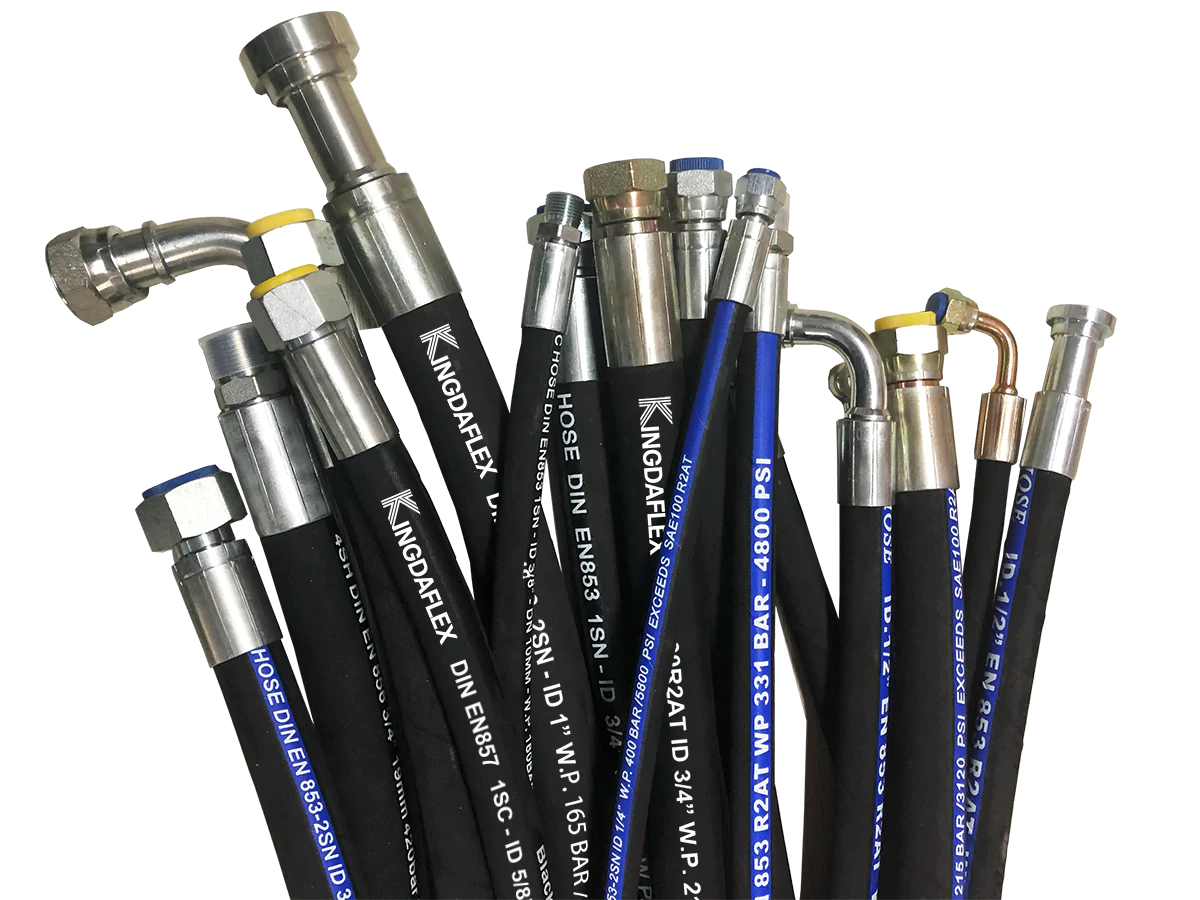
Yes. Custom hydraulic hoses can be supplied with private-label printing, customer part numbers, barcodes, QR codes, branded cartons, individual bags, reel labels, fitting caps, and pallet marks. A 2020 ISO specification for spiral-wire hydraulic hose covers nominal sizes from 6.3 mm to 51 mm and operating temperatures as high as +120°C for selected hose types, so branding has to remain separate from information needed to identify the hose specification. For an OEM ordering 10,000 assemblies across 50 SKUs, accurate labeling and packaging can also reduce receiving, sorting, and installation errors while keeping each batch identifiable.
A manufacturer can normally place a customer name, logo, product family, hose size, pressure class, standard reference, lot code, and production information on the hose cover. The practical limit comes from printable surface area: a 1/4-inch hose has far less room than a 1-inch hose, while repeat spacing must still leave technical information readable after the hose is cut into shorter assemblies.
For private-label work, a buyer should therefore define the information hierarchy before approving artwork. A 2026 order containing 30 hose sizes does not need 30 unrelated layouts; one controlled template can keep the logo position, font size, date-code structure, and part-number format consistent while technical fields change by SKU.
Branding should not replace information used to identify the hose, its specification, or its manufacturing batch.
ISO 3862:2020, for example, covers five types of spiral-wire-reinforced hydraulic hose in nominal sizes from 6.3 mm through 51 mm. It specifies service ranges of −40°C to +100°C for 4SP and 4SH types and up to +120°C for R12, R13, and R15 with specified oil-based fluids. A printed brand therefore sits alongside engineering identification rather than becoming the only marking.
Layline printing is usually the first branding method considered because it stays on the product after the carton has been discarded. Depending on manufacturing capability, printing can repeat at set intervals so a cut hose section still carries identification; for a distributor selling 20 m, 40 m, and 100 m coils, repeated marking is more useful than one logo printed near the beginning of a reel.
The text can include:
-
Brand name and logo
-
Customer hose-series name
-
Nominal inside diameter
-
Working-pressure identification
-
Applicable SAE, EN, or ISO designation where appropriate
-
Production date or lot reference
-
Customer SKU or internal product code
Printed information needs to be checked against the actual construction. A hose should not carry an SAE, EN, or ISO reference simply because the buyer wants that wording on the cover; the product must meet the specification being claimed. In 2026, ISO is already developing Edition 6 of ISO 3862 to replace the 2020 edition, so manufacturers and buyers also need document control when standards are revised.
Logo customization is simpler than engineering customization. Changing a logo, text sequence, carton graphic, or label normally leaves the hose construction unchanged, while changing cover compound, reinforcement, inside diameter, bend characteristics, or temperature capability creates a different technical manufacturing request.
That distinction matters when a buyer requests a special cover color. A standard black cover with customer printing may use an already qualified compound; asking for blue, red, or another non-standard cover can require a different formulation or production setup. For an order of only 500 assemblies, colored tags, spiral guards, labels, or sleeves may be more practical than altering the rubber cover itself.
Finished assemblies offer more branding space because information can be carried on both the product and its packaging. A label can show the OEM part number, assembly length, fitting description, production lot, barcode, and inspection status without crowding the hose layline.
A program with 60 SKUs illustrates the benefit. Two assemblies might both use 1/2-inch hose but differ by only 50 mm in length, a 45° fitting, or a different thread. A warehouse employee cannot reliably separate all 60 configurations by appearance, while a printed SKU and scannable code provide a consistent identification method.
| Identification item | Hose layline | Assembly label | Carton label |
|---|---|---|---|
| Brand/logo | Yes | Yes | Yes |
| Hose size | Yes | Yes | Yes |
| Assembly length | Limited | Yes | Yes |
| Customer part number | Possible | Yes | Yes |
| Barcode/QR code | Rare | Yes | Yes |
| Batch reference | Yes | Yes | Yes |
| Quantity per carton | No | No | Yes |
Barcode and QR-code content should match the customer's warehouse system rather than being selected by the hose factory without instructions. A GS1-compatible requirement, Code 128 field, internal numeric SKU, or QR-linked service record can require different label dimensions and data structures. With 1,000 cartons and 24 assemblies per carton, one incorrect barcode template can affect 24,000 units even when every hose has been manufactured correctly.
Packaging therefore needs its own approved specification. Bulk hydraulic hose is commonly supplied in coils or reels, while crimped assemblies are more often packed in bags, cartons, crates, or palletized groups. Products related to industrial hoses may use similar outer-packaging methods, but hydraulic assemblies often need greater attention around machined fitting ends and sealing surfaces.
A basic assembly pack can contain one hose, two protective end caps, one identification label, and one bag. Larger OEM programs may specify 5, 10, or 20 assemblies per carton, maximum carton weight, pallet quantity, carton numbering, purchase-order references, and mixed-SKU restrictions.
A package specification should state exactly what goes inside one bag, one carton, and one pallet.
Fitting protection deserves particular attention because branding cannot compensate for damaged sealing surfaces. JIC flares, metric sealing faces, BSP connections, ORFS faces, and other machined ends can be capped or plugged before packing. On a shipment of 5,000 assemblies, specifying two protective caps per assembly requires 10,000 caps, making the item a purchasing and inspection requirement rather than a minor packing detail.
Custom cartons are available, although volume affects cost. Printing a logo directly on corrugated boxes usually requires dedicated artwork and a carton production run, while a neutral carton with a customer label can be changed more easily between SKUs. A distributor managing 80 part numbers may therefore use one or two standardized carton sizes instead of stocking 80 printed box designs.
The label can then carry variable data: hose family, size, quantity, batch, SKU, purchase order, gross weight, and carton number such as “12 of 48.” This method keeps visual branding consistent while reducing the number of packaging materials held in inventory.
MOQ should also be discussed separately for each customization method. A supplier may accept several hundred custom labels because they can be digitally printed, while custom hose layline preparation, colored covers, printed reels, or lithographic cartons may require much larger runs. A quotation for 200 pieces should therefore not be assumed to have the same customization options as an annual program of 50,000 assemblies.
Order frequency matters as much as first-order quantity. An OEM buying 5,000 units every quarter provides a different production case from a buyer ordering 5,000 units once. Repeat programs allow printers, labels, carton artwork, and SKU files to be maintained under revision control, provided both parties agree how obsolete artwork is removed when specifications change.
Before mass production, an approval sample should show the real arrangement of hose marking, fittings, caps, labels, and packaging. Reviewing only a PDF artwork file may miss issues such as text wrapping around a small-diameter hose, a barcode placed over a bag fold, or a carton label hidden by pallet stretch film.
For 25 SKUs, buyers do not necessarily need 25 full shipping pallets as samples. Representative approval can cover the smallest and largest hose diameters, several fitting geometries, and each packaging format, while variable text is checked against a controlled SKU list. Technical markings, customer part numbers, and barcode data should be approved separately from visual artwork.
Traceability should continue after branding is applied. A private-label product may show the distributor's name to the end customer, but the manufacturer still needs internal records connecting the production lot to materials, production date, inspection information, and relevant test records.
ISO 3862:2020 covers hose and hose assemblies but does not establish requirements for end fittings, and it specifically places fluid compatibility responsibility on the user in consultation with the manufacturer. A branded assembly program therefore needs fitting specifications and hose compatibility requirements in addition to the logo file.
Testing requirements should be agreed by product family rather than inferred from package graphics. A carton printed “high pressure” is not an engineering specification. The purchase document should identify the required hose standard, pressure class, temperature range, dimensions, fittings, and any test or inspection requirements before packaging instructions are added.
In 2020, ISO 3862 widened specified water-based-fluid temperature ranges compared with its withdrawn 2017 predecessor for covered hose types, illustrating why controlled standards references matter when products remain in a catalog for several years. Old artwork should not continue indefinitely when the product specification or referenced standard has changed.
Export orders add another layer because a pallet may pass through a factory warehouse, truck terminal, port, container, import warehouse, distributor, and customer before installation. Packaging may therefore include purchase-order numbers, carton sequence, gross and net weight, dimensions, country-of-origin information where required, handling marks, and customer warehouse labels.
A shipment containing 12 pallets with 40 cartons per pallet creates 480 carton-level identification points. If cartons contain multiple sizes, a packing list needs enough detail to show which SKU and quantity are located in each carton rather than forcing the importer to open hundreds of boxes during receiving.
For OEM supply, packing quantity can be matched to production consumption. If one machine uses four identical hose assemblies and the equipment plant builds 25 machines per production batch, cartons of 100 assemblies can reduce repacking at receiving. Another customer may prefer individually bagged assemblies because each hose is issued separately to a service location.
Brand ownership also needs to be documented. The buyer should supply an approved logo file and confirm authorization to use the trademark. The manufacturer should retain the current artwork revision and prevent customer-branded material from being mixed with another order. For a factory serving 40 private-label customers, file names such as “logo-final-new2” are inadequate; revision numbers and approval dates reduce artwork mix-ups.
The purchase specification can be kept compact:
-
Hose standard, size, pressure rating, and temperature requirement
-
Fitting type, thread, material, angle, orientation, and assembly length
-
Layline wording and repeat arrangement
-
Logo artwork revision
-
Customer SKU and barcode format
-
Lot or date identification
-
Caps, plugs, sleeves, or other protection
-
Units per bag and carton
-
Carton and pallet label fields
-
Sample-approval status
-
Artwork revision date, such as 2026-08
-
Quantity per SKU and expected annual volume
A supplier quoting 15 different hose assemblies can use the same file to price manufacturing, printing, labeling, and packaging instead of interpreting branding from email screenshots. When one SKU later changes from a 90° fitting to a straight fitting, the revision can be limited to the affected drawing, label, and packing record rather than recreating the entire private-label program.
For buyers comparing suppliers, ask for a production sample rather than evaluating branding from catalog images alone. Check whether the layline remains readable on the smallest diameter, scan 20–30 barcode samples with the warehouse scanner, inspect caps after transport, measure the finished assembly, and compare the carton label with the purchase order.
A 30-piece pre-production sample can reveal inconsistent print spacing, label adhesion, incorrect fitting orientation, damaged caps, or packaging that is too tight before a 10,000-piece order is released. Approval records should state which sample, drawing revision, artwork revision, and packaging specification were accepted so later production has a fixed reference.